How Sustainable Food Powered Elite Skiing at the Alpine World Cup in Åre, Sweden - Interview with Olle Danielsson Klippinge, Ski World Cup 2026 Åre, Managing Director
- AnitaJozsef

- Mar 23
- 2 min read
Updated: 2 hours ago
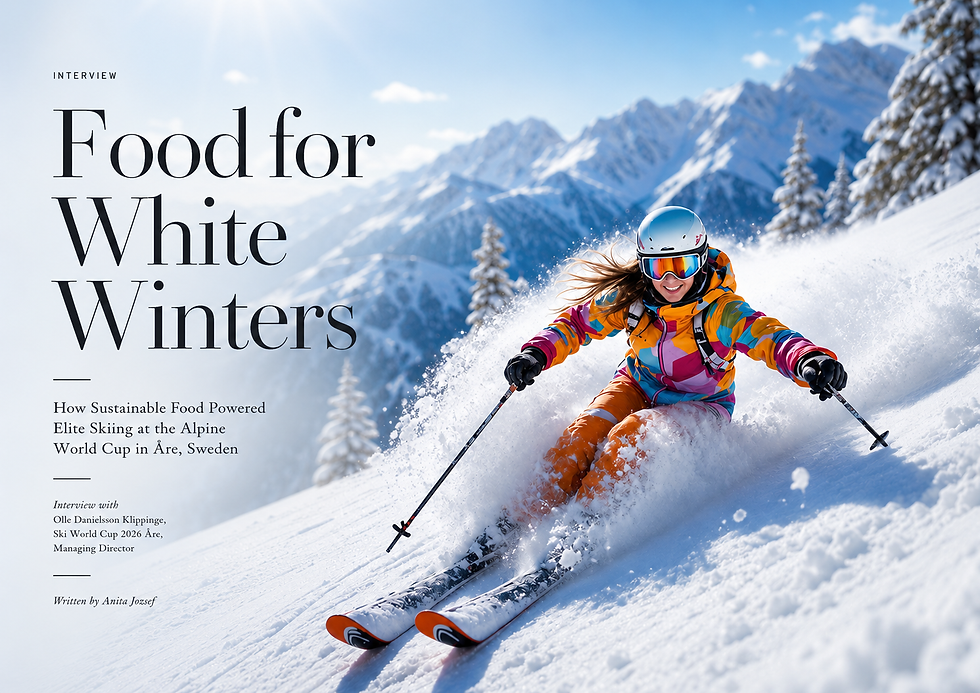
From 13–15 March, the Nordic Sustainability Arena took place in connection with the Audi FIS World Cup in Åre. While the world’s top alpine skiers were preparing for their victories, researchers, organizers and decision-makers focused on another kind of performance: sustainability in sport catering.
At the heart of this effort was the Food for White Winters project, an initiative exploring how major winter events can serve nutritious, high-performance meals with a lower environmental footprint. For the Ski World Cup 2026, it was not just theory: the project was being tested directly on the plates of athletes.
From conversation to action
According to Olle Danielsson, CEO of Ski World Cup 2026, the project started with a discussion rather than a formal plan.
“Last year, at the Nordic Sustainability Arena, I was sitting with Gunnhild Stordalen from EAT
Foundation, Susanne Sieff from the International Ski Federation (FIS), and Per Olsson from the Stockholm Resilience Centre. We talked about food and its impact on nature, especially in the context of the Ski World Cup, where athletes depend on meals for their performance. That’s when the idea for Food for White Winters really began to take shape.”
Through the project, Åre acted as a “test lab” for sustainable, athlete-focused catering. It’s a collaborative effort with FIS and Stockholm Resilience Centre, aiming to understand what’s feasible when budgets, seasonality and local supply chains are taken into account.

Menus under the microscope
The initiative was not about cutting corners to look sustainable. Restaurants prepared menus that were reviewed by researchers and nutritionists. Each meal was assessed for its climate impact and compared with last year’s baseline to calculate real reductions in emissions.
“Right now, menus are being finalized,” Olle Danielsson explained to me. “We then forward them to scientists to calculate the impact. The goal is to see what we can actually achieve.”
At the same time, the meals had to meet elite athletes’ nutritional needs. Linda Bakkman, nutritionist for the Swedish Olympic Committee, ensured that every plate provides the right energy, protein, and recovery potential.
“The challenge was to balance sustainability with performance,” Danielsson said. “Athletes can’t compromise on energy.”
The meat dilemma
One of the biggest hurdles in the Food for White Winters project was protein, specifically, how to reduce meat without affecting performance. “Do we really need 200 grams of meat per meal?” Danielsson asks. “Or can we reduce that while keeping energy levels high?”
The solution was not just culinary, but scientific: combining plant-based protein, seasonal vegetables and locally available ingredients while maintaining the demands of elite sport. Seasonality was another factor. Winter in northern Sweden offers limited fresh produce and procurement cycles for large events are long.
Lessons beyond Åre
Because FIS is directly involved, the project had ambitions beyond a single event. The goal was that successful strategies from Åre would provide guidelines for other Ski World Cup organizers, spreading lessons from sustainable catering across international winter sports.
“We want solutions that can be scaled,” Danielsson says. “What we test here could influence how other FIS Ski World Cup events are organized in the future.”
Thank you for the interview Olle Danielsson Klippinge. Gratulerer så mye Nordic Sustainability Arena!




Comments